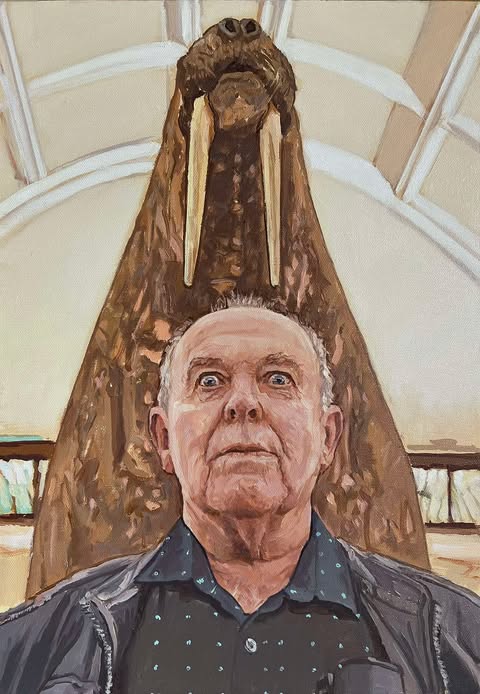
Early in January 2025 an invitation comes by email from Italian portraitist Luca del Baldo, not known to me previously (I’m vastly ignorant) — for me to be portrayed in oils based on a suitable photograph… and an adventure starts…
Luca tells me how a previous project of his resulted in a book entitled The Visionary Academy of Ocular Mentality. Atlas of the Iconic Turn published by the German publisher De Gruyter in 2020.
I duly receive a pdf of The Visionary Academy featuring art historians and allied scholars, their oil paintings by Luca and their comments unguided by Luca and also uncommented by him, otherwise the spontaneity of the project will fail. I duly read at various speeds what range from lengthy academic art history essays to simply “Thanks for the painting” and nothing more, which seems a bit meagre, but Luca refrains from comment on the responses. This first book was funded by the Edith O’Donnell Institute of Art History at the University of Dallas Texas.
A second project also for publisher De Gruyter involved contributions from US art critic/philosopher Arthur C. Danto (who died in 2013) to Slavoy Zizek
Now, pursuing a wider palette of writers, poets, and movie directors, there’s a cast list from Russian film maker Alexander Sokurov to Spanish novelist Javier Cercas, onward maybe to me or not. There’ll be at least 40 portraits — based not on sittings in the flesh, but on a recent photo, hopefully unconventional, perhaps taken in free time or revealing secret or intimate passions, preferably not academic images nor writers in front of their typewriters or computers, as often, maybe too often, in The Visionary Academy volume. Please can each participant provide a comment/reflection on the portrait itself or upon this experience. This can be just two lines or an essay of several pages. In return Luca sends the physical painting as a gift. Finally Luca will try to publish a book, whether in Italy or elsewhere. This is a totally independent and self-financed project. No gallery nor publisher is imposing anything on Luca nor helping him. He has full autonomy in his choices. The project is pure.
Ian to Luca by email, 12 Jan 2025:
Attached are some pictures of me. Not too many, I hope. The photographer is my Spanish wife Cristina who is extremely proficient and has a haversack of camera equipment, though lately she mostly uses her smartphone followed by Photoshop of which she is a mistress. My own phone is a dumbphone. I always carry it just for emergencies such as falling down in the street. I’m told that my dumbphone has a camera but so far I have never taken a Selfie. Cristina likes to take photos of me, and I like to act as director unless slapped down by superior insight. Or if I take more time than Stanley Kubrick to frame a shot.
I may well be taken down a peg or two by the coming experience of portraiture. Nowadays SF authors are constantly posting pictures of ourselves on social media to endear persons and/or our books. The perfect ‘author photograph’ is a preoccupation, even if many pictures printed on dust covers strike me as banal. Don’t judge a book by its cover but do feel free to judge it by the author photo….
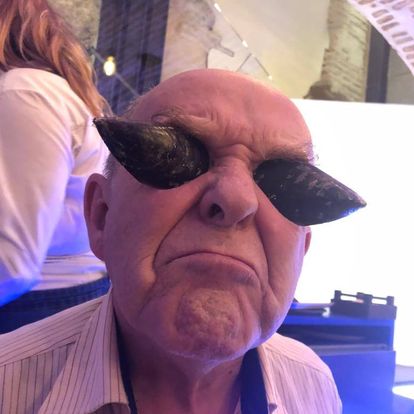
For fun I add photos of me in a restaurant in Toledo where I hide my eyes behind mussel shells (photo by David Luna):
and another where I fight to escape from my own giant face
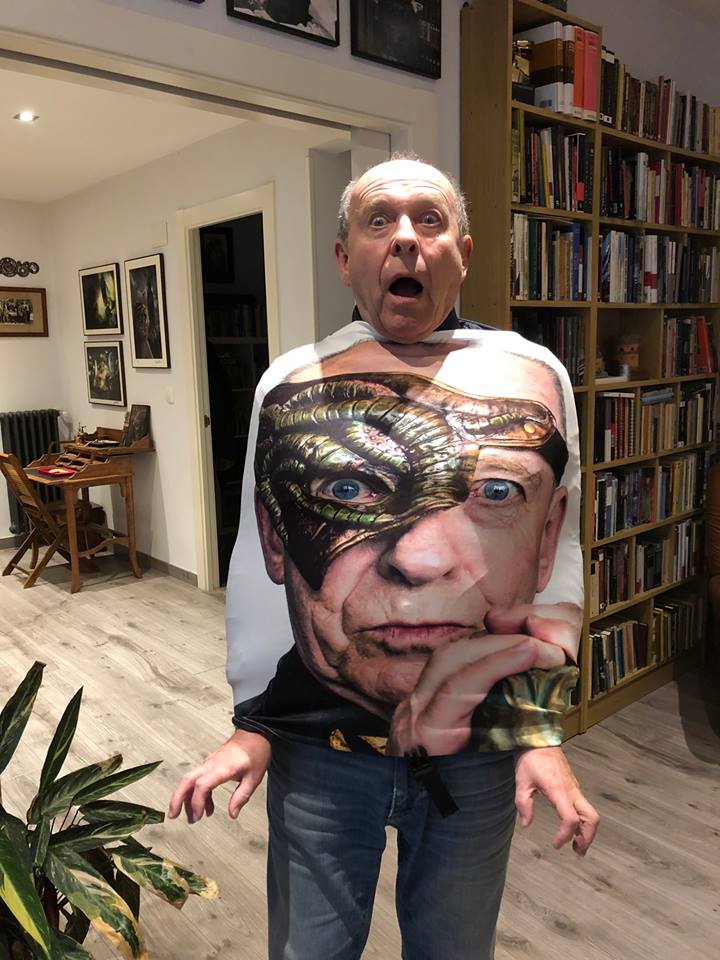
A few years ago personalised suitcases cover were being advertised briefly, so that you could spot your own luggage quickly on the airport belt. I have never seen any in use anywhere. We bought a face-only suitcase-cover just for fun.
Fun is important in the presentation of self. To “occularity” maybe I should add “jocularity”. I’m mostly merry—even though I’m certain that our global civilisation will collapse within 50 or 60 years along with much of nature due to our own stupidity and greed. Horrible stages will lead within a few hundred years of increasingly violent ignorance to our extinction, which will spell at the same time the demise of all intelligent life in the entire universe, no kidding. Advanced life on Earth is like winning a lottery a million times in a row. Don’t expect to find any more fertile eggs in the cosmic basket.
The tipping points have already tipped over. Capitalism, not least Chinese Communist capitalism, is out of control. Economic growth isn’t good but on the contrary is our planetary death sentence, forced upon us by fools. We have just (January 2025) gone through the sacred 1.5% C red line for global temperature years earlier than predicted. Besides this, personal death pales completely. For here comes the Great Death — of advanced intelligence, of rational thinking itself. Following upon our genocides of other human species, we will genocide ourselves.
My eyes: I can see clearly into the far distance, and I notice things that other people don’t notice such as a bizarre bird resembling a demon next to a chimney pot. For the past 30 or 40 years I’ve used reading glasses. Both my eyes are very similar, so I can buy glasses in a supermarket. I only realised that my eyes are blue when a Spaniard told me so after my first 50 years. Until then I thought my eyes were a sort of grey.
Taking LSD a dozen times helped show me the structure of my perceptions. In Oxford Botanic Garden simultaneously I saw every beat of a bird’s wings speeding across my field of view, akin to viewing Duchamp’s Nude Descending the Staircase. In a park in Leamington Spa two magpies alighted a few yards apart and proceeded to walk away from one another. I forced myself to continue watching the same spot exactly between them (instead of tracking one or other of the magpies even momentarily) until, as I knew must happen, half way to my visual boundary, both birds vanished; happy day. Occasionally I have crystalline migraine haloes, which I watch till they disappear always within 30 minutes so far. A few months ago unaccountably I told an interviewer that I was looking at a crystalline halo, and the man declared with joyful amazement how he never knew that other people experienced haloes; till then he believed himself uniquely cursed. He’d been scared all his life that he would lose his vision. Oddly, never before did I mention migraine haloes to any other stranger. Maybe I’m a voyant.
Regarding art, I was alerted to Bosch (for his bizarrity) thanks to Henry Miller’s Big Sur and the Oranges of Hieronymus Bosch borrowed from my local Tyneside library when I was 11 or 12. In Britain at the time Miller’s major books were banned for obscenity. On a lone trip to faraway London — with money earned by employment over Xmas as a sorter of a lot of greetings cards in the local Tyneside post office — I bought a copy of Fränger‘s monograph The Millennium of Hieronymus Bosch which I still treasure. Years later I landed a fictional starship on a world modelled after Bosch’s triptych.
The day-long coach trip from Tyneside was to stay with my only aunt in her mansion by the Thames, complete with motor boat. My aunt had run away from barren Tyneside prior to World War Two to be a good time girl in London. A black marketeer became enamoured of her. The pair came out of WW2 with a de luxe mansion, a chain of bakeries, lots of cash, but Eva’s mere existence was censored from my few kindred due to bourgeois hypocrisy.
My final job before I went freelance as a science fictioneer in 1976 was as Senior Lecturer in the School of History of Art in Birmingham UK (now scarcely identifiable even by archeologists). However, what I was ‘teaching’ to students of art and design and fashion wasn’t the history of art but futures studies including science fiction. My job was general culture and I could ‘teach’ whatever I wanted. As colleagues I had: a burly Hungarian iconographer, a whitening-bearded historian of Chinese Art, a glamorous fashionista fresh from Firenze, a marxist social anthropologist, an elegant slim semiotician, and a beer buddy graduate of the Courtauld Institute with an Anglo-Irish name who sourced our LSD. Together Brendan and I produced, printed, and handed to a puzzled public in the streets of Birmingham Situationist pamphets in the vein of Guy Debord and Raoul Vaneigem. A perfect mix of colleagues to stimulate my fiction. I sound as if I’m trying to fit in with a portfolio of art historians as per Luca’s volume one, but I’m not, honest injun! I’m a chameleon, a bricoleur. I did do the academic lit-crit thing, including publications in journals, but that was in a century long ago and far away.
My previous two ‘jobs’ were firstly as a lecturer in world literature at University College, Dar es Salaam, Tanzania. The university, very well funded due to recent independence from Britain, hired too many staff, so I only had a couple of classes to teach. To pass the time I swam, played darts with Sikh car mechanics (turbans), drove my VW as far as Kilimanjaro, raced through a perilous bush fire. But there wasn’t enough income to travel much. Life in East Africa was limited and boring culturally; West Africa was envied and even resented. I read Passing Time by Michel Butor.
For my middle job I went to Tokyo, which was the opposite of boring. The radical Zengakuren students at my state university went on strike for two and a half years during which us ‘professors’ (sensei) did no work but received 5 increases in salary; so I happily explored that futuristic city. I sold my first SF story, to innovative New Worlds SF magazine, “Roof Garden under Saturn”, about life on top of a Japanese department store; literal to me, fantastic to them in London.
By 1976 I stopped having any jobs. Except for Kubrick, later on.
28 January 2025:
Luca tells me of his project in France concerning portraits of Marcel Proust:
(CLICK ON THE LINK.)
Here’s the full Proust painted by Luca:
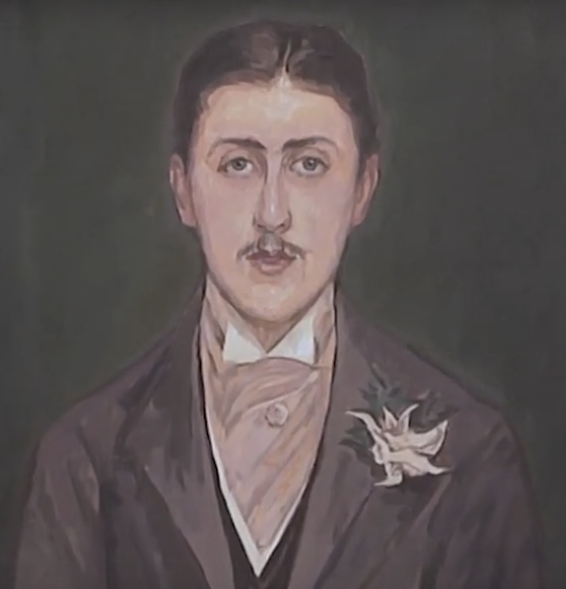
Oddly, this is the second time Proust has recently reared his head in my life. A few months ago in order to write a short story a year or so hence I needed to read a newly published book by my chum from 1967, Bertrand Méheust, whose Science Fiction & Flying Saucers I reviewed in Dick Geis‘s Science Fiction Review in 1978. Bertrand’s new book, Proust Voyant, insists that Proust was a powerful psychic medium. Well, maybe not so, though thanks to Bertrand for the effort. I first met Bertrand at the second French National SF convention in 1975. This led to him visiting me in Oxford and spitting in my face since he despised Royal families and the Queen owns all the swans on the Thames, but the wind was blowing the wrong way. Enough about swanns and their ways.
Italian surrealist chum and collaborator Roberto Quaglia from Genoa made and makes good pics too, in case he sees this. Cristina and me and he all drove together to Torino last year in Roberto’s Dacia Duster SUV. Luca lives in Como, which we didn’t know at the time. We could have gone there during the day. I’m pledged to write a story set in Torino, promised with pictures on my website (https://www.ianwatson.info/the-twenty-first-day-of-turin/).
As I grow older (over 80 by now) I become more jocular than I was half a century ago when first I started being published. I’m always on the lookout for photo opportunities to result in pictures of me for magazines and book covers—photos which are fun, not saintly, noble, solemn, or pretentious. So I was particularly happy when maestro Luca del Baldo chose Cristina’s Walrus photo for my portrait, very kindly offered to me from out of the blue.
26 to 28 May 2025:
When the painting arrives and gets unpacked, I’m not expecting my first reaction! I’m startled by the painting, because my eyes look so luminous, so penetrating. Penetrating as the tusks of the walrus. And then, at the very top of the animal, I noticed its nostrils next. And the animal has no eyes; it only has (or uses) my eyes. There’s such fearful symmetry, as William Blake wrote about The Tyger.
After a while I wonder if the true dynamic of the portrait is different—whether the walrus might be pulling its tusks upward from out of the back of my head. Might it have extruded my clad body and my head including person through those piping tubes, as a cake decorator pumps out icing or dough. Only when the tubes pull loose and lift upward am I aroused to the astonishment of my first instant of awareness. I’m the alien’s intermediate in our world, its voice, its communication. A sort of ventriloquist’s puppet. Newly deposited, maybe only my upper part with the useful lungs, setting very fast.
This is obviously a fanciful interpretation, though it does account for the astonishment visible in me.
Later still, as I stare obsessively at the painting, propped upon a table in a room well illuminated by spot lights in the ceiling, and myself in an armchair with a glass of red wine (Ribeira del Duero), I become aware of something apparently actual that I can’t account for. Scarcely noticable (until one notices) the painting sparkles with minuscule spots of light like a multitude of very far-off stars, a regular array, a cosmic background for the alien beast.
Reflections from mica in the paint, suggests Cristina, an explanation we soon discard. Yet the word fleck lingers. Re-fleck-ting. Those tiny fixed stars aren´t sparkles or twinkles or scintillae. They don’t wink.
So I bring a big magnifying glass, which incorporates lights that switch on and off. And I realise that I’m seeing the texture of the canvas itself. All the tiny bumps of the weave. Which may be primed with a waterproof coat of PVC or gesso—items unknown to me until now. Until now I never looked at a canvas closely, only at what is depicted upon the canvas. Till now I was unaware of what is behind, what is underneath, a painting. But this is irrelevant to my experience of the painting itself! I must ignore that background field of tiny stars, purely an artefact of artificial lights re-fleck-ting from weave.
On 29th May 2025 Luca comments upon my comment:
<<A great French Art historian, Daniel Arasse, wrote a book: Le détail: Une histoire rapprochée de la peinture. Each painting acquires new life by seeing it from the real, the photographic or video reproduction resets many of its true forces between itself and the eye-spectator.>> This does inform me, though as per project it refrains from commenting pro or con.
18 June 2025:
After delays caused by Life we carry the Work to our favourite framing shop… and on 24 June 2025 home comes the framed painting, to be hung in a corridor of framed pictures (few of them actual paintings) the following morning:
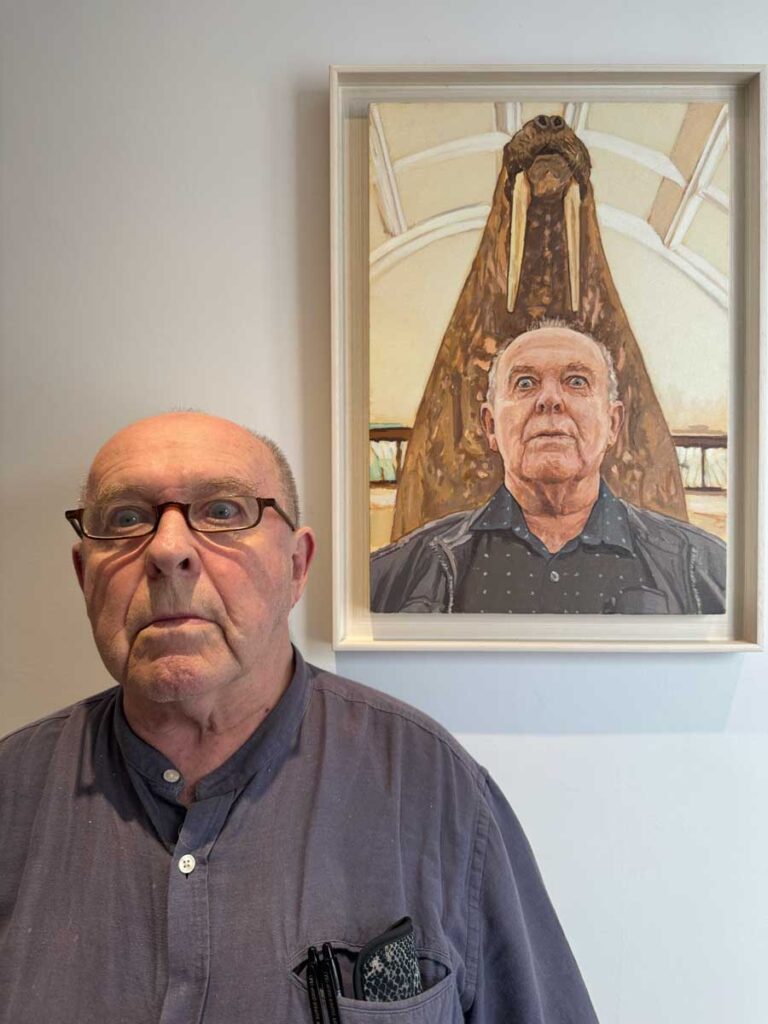
And oh my Ghod this shocks me because the framed Work is now much more authoritative.
“Who is that?” I exclaim at seeing myself now live and loose in a photo of part of the corridor. “Do I really look like that? I want a new body!”
I feel displaced. It’s a disturbing sensation.
Here’s a wider view of the corridor taken at the same time:
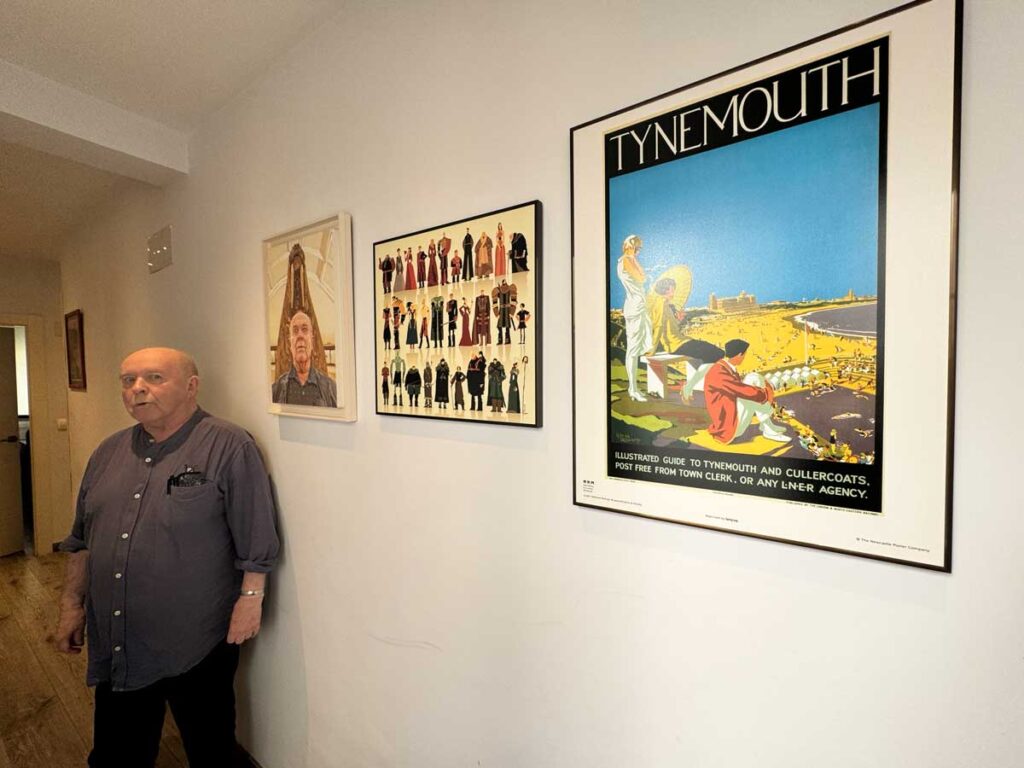
To the right of the Work are charicatures of the persons in George Martin‘s Games of Thrones saga, which Cristina translated. Closest to the viewer is a railway poster (London & North-Eastern Railways company) from 1924 aiming to attract posh people from the south to visit Tynemouth, the town where I went to school. The three sophisticated persons on the left almost certainly never visited Tynemouth, since the holiday trade was mostly Scottish working class. Yet hang on! The fun palace in the middle distance was called The Plaza (which local people were certain is the Spanish word for Palace). Further on was The Spanish City, a walled funfair muralled with scenes of fiesta and flamenco. Why? For fun! In the opposite direction was The Spanish Battery where King Henry VIII paid Spanish mercenaries to guard the entry to the River Tyne — this was half a century (-ish) before his then-55-year-old daughter Elizabeth 1st, Gloriana, defeated the ‘Invincible Armada’. (‘Armada’ as a word on its own means any old fleet, nothing special.) Gijón, the seaside holiday destination for the Spanish where I now live, and Tynemouth, resemble one another in weird coincidental ways, from the Long Sands (above), to our Playa San Lorenzo, both targets for Vikings at around the same time, not to mention others aspects. To my astonishment I first saw this poster of Tynemouth in an otherwise ordinary coffee bar in Santander. How was it there?
I’m very uneasy.
Please peer at the far corner of the swimming pool. That’s where I failed to learn to swim, mainly because in the summer my school scheduled hours for swimming but didn’t actually teach any swimming. Consequently I would float there for thirty minutes, hanging on to the side. It was only on the Venice Lido some years later that I finally learned to swim because to my horror I saw through the ripple of water that the sand half a metre beneath me was a carpet of crabs. Up toes, and survive! This prepared me for the coral reefs of East Africa, where one time a stingray the size of myself swam underneath me lazily trailing its sting.
Next morning I feel less displaced. I’m no longer estranged, just a bit wary.
But I expected none of this stuff.
Gijón, Asturias, 29 June 2025


A fine portrait, Ian. I know Luca, and he showed his painting to me a while back, I think at an intermediate stage, because he knew of my live for your work. He’s a fine portraits, rated among tge best in the world I believe. I have a portrait of Ballard in his later years by him.